deutsche ausgaben
Foreword:
The Blind Spots of Global Reporting (November–December 2023)
In the final months of 2023, the eyes of the global public were firmly fixed on al-Shifa Hospital in the Gaza Strip. While international media heavyweights—including American heavyweights such as The New York Times, The Washington Post, and The Wall Street Journal, alongside prominent British newspapers like The Guardian, The Daily Telegraph, and The Times, as well as major broadcasters like the BBC—reported extensively on military operations, the medical crisis, and the contradictory statements of the conflicting parties, their coverage suffered from a profound systemic flaw.
International mainstream reporting largely followed the official narratives of the information war. While The Wall Street Journal reported on Israel releasing footage intended to prove that the compound was used by armed fighters, The New York Times focused on official video releases showing tunnel infrastructure beneath the besieged hospital, and The Washington Post published open-source deep dives into military claims, these major outlets remained trapped within a narrow framework: they focused primarily on macro-level military infrastructure, tunnel allegations, and institutional statements.
What was missing from nearly all major Western reports during those critical weeks was the micro-level forensic reality of visual material produced by the actors themselves. While major newsrooms analyzed satellite coordinates and official releases, they overlooked or concealed the immediate, local choreography at the hospital gates and courtyards—including the unimpeded movement of local participants documenting the aftermath of the October 7 events.
This investigation fills that gap. It does not offer a general overview of wartime politics; rather, it provides a forensic, frame-by-frame reconstruction of the path taken by the hostages and their captors. By combining geolocation, frame-by-frame video analysis, and contemporaneous field communications, this dossier challenges the uncritical or restricted framing accepted by major global media in late 2023—and delivers the definitive documentation that was missing at the time of reporting.
Shortly after 10:40 a.m. on October 7, a large number of vehicles drove through the gates of al-Shifa Hospital, the largest medical complex in Gaza. These were not ambulances, and they were not transporting wounded terrorists. They were transporting Israeli hostages.
Newly surfaced exclusive Palestinian video footage now proves that al-Shifa Hospital served as a key Hamas command center for the transfer and distribution of abducted Israelis.
Of particular significance to this investigation are two videos that appeared only briefly on a Palestinian Telegram channel. They show abducted Israeli vehicles being driven onto the al-Shifa Hospital grounds.
This is the first time this material has been publicly presented in this form and properly analyzed.
Previously, official evidence suggested that only two or three hostages passed through al-Shifa Hospital on October 7. The following evidence, including single-frame analysis of previously unreleased footage, shows that this figure is significantly underestimated and that the actual number was much higher.
One of the most revealing aspects of what happened at al-Shifa is not just what occurred, but what did not occur. Although prominent journalists from Gaza were present, none reported on the arrival of the hostages. One even falsely portrayed a jeep full of captured Israeli women as „injured Palestinians“ brought in for medical treatment.
Warning: This article contains disturbing footage of hostages taken on October 7.
The Hostages from Nahal Oz
On the morning of October 7, one of the gravest failures in IDF history occurred at the Nahal Oz military base near Gaza. The base was quickly overrun by a large number of terrorists, and more than 20 soldiers were killed there—including 16 female spotters/observers.
Ten living hostages were abducted from the base—seven female observers and three members of a tank crew.
In May 2024, with the consent of the families, a longer video titled „Nahal Oz Military Base, October 7, 2023, around 9:00 AM“ regarding the female hostages prior to their abduction from al-Shifa was released. A single-frame analysis of the entire video now shows that six hostages were forced into a single stolen IDF jeep: four female observers, all visibly alive at the time and being led to the jeep; a fifth hostage, likely also an observer, lying injured on the floor of the vehicle (presumed to be Noa Marciano*); and a sixth, a soldier who was apparently severely injured or already dead:
The
Hostages
from
Nahal Oz
On the morning of October 7, one of the gravest failures in IDF history occurred at the Nahal Oz military base near Gaza. The base was quickly overrun by a large number of terrorists, and more than 20 soldiers were killed there—including 16 female spotters/observers.
Ten living hostages were abducted from the base—seven female observers and three members of a tank crew.
In May 2024, with the consent of the families, a longer video titled „Nahal Oz Military Base, October 7, 2023, around 9:00 AM“ regarding the female hostages prior to their abduction from al-Shifa was released. A single-frame analysis of the entire video now shows that six hostages were forced into a single stolen IDF jeep: four female observers, all visibly alive at the time and being led to the jeep; a fifth hostage, likely also an observer, lying injured on the floor of the vehicle (presumed to be Noa Marciano*); and a sixth, a soldier who was apparently severely injured or already dead:
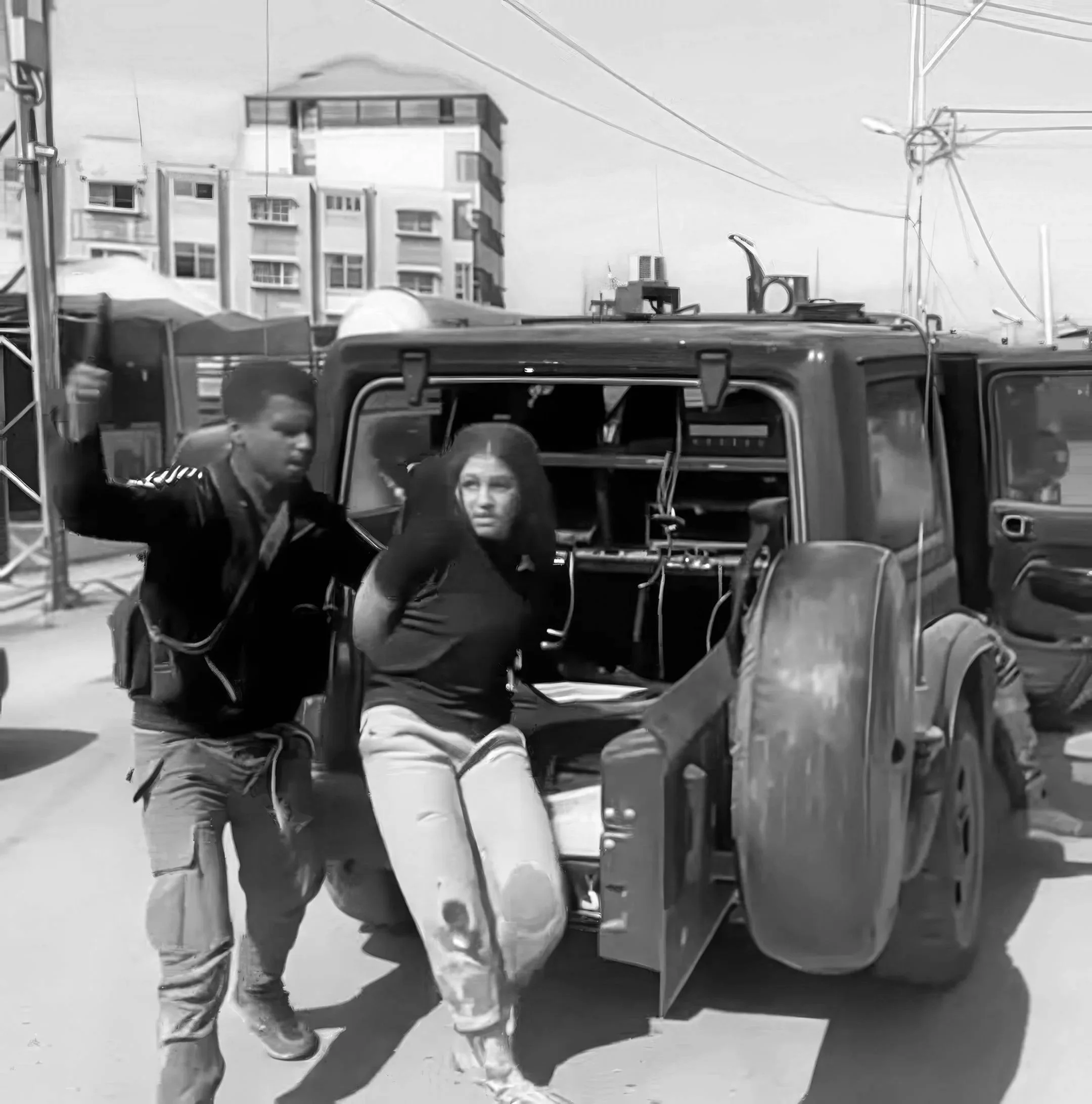
By searching dozens, if not hundreds, of Telegram channels, further clues were found, allowing part of the journey of these two vehicles to be tracked. The decisive evidentiary details captured in all the film material used here are the license plates 703-145 and 507105 of the vehicles, the 3 bullet holes in the windshield, the broken small front right headlight, the special features of the black jeep, and the accompanying terrorists and hostages.
This footage was recorded shortly after the stolen vehicle entered Gaza City. It was found on only a single Telegram channel from Nablus. In the clip, the jeep carrying the hostages from Nahal Oz drives through a narrow street in the Shuja’iyya district of Gaza. License plate 703-145 is clearly visible. Civilians cheer as the stolen jeep and other vehicles drive past. The street visible in the clip is Riyadh Street in the Shuja’iyya district. The jeep travels westward toward Rimal and the coast.
The visible landmarks allowed for an exact geolocation of the footage (geolocation credits go to “TwistyCB” on X):
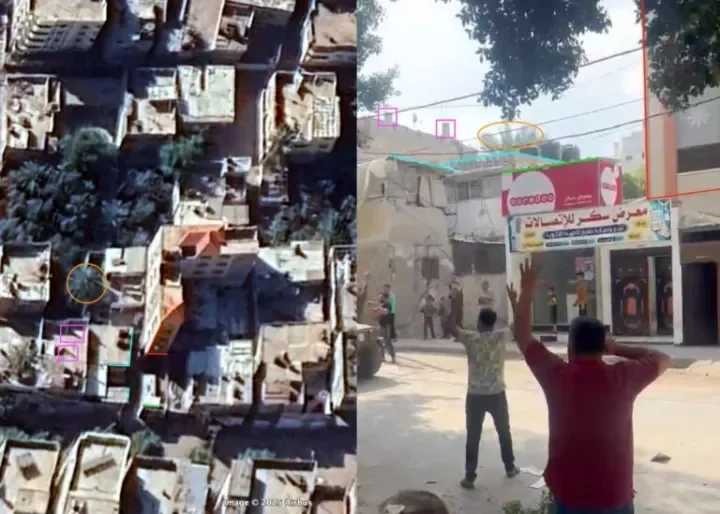
Another useful image from the same Telegram post shows the vehicle shortly before the turn—three distinct bullet holes are visible in the windshield, a telling feature allowing definitive re-identification later.
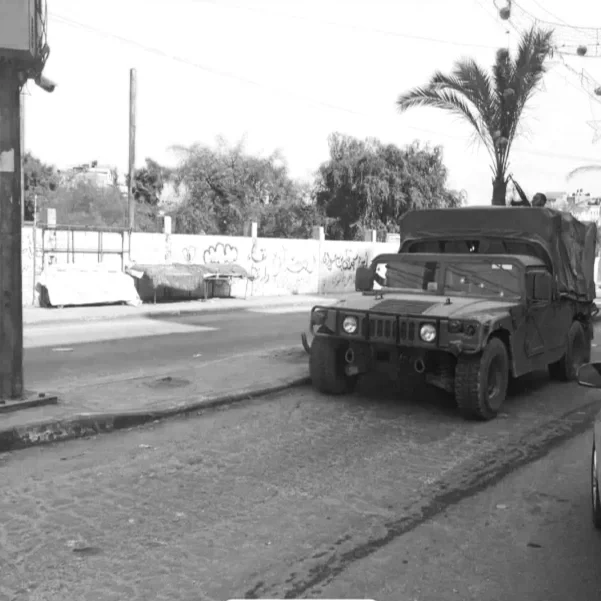
Naama Levy was dragged from the back of the black vehicle and pushed onto the rear seats when the black jeep stopped in Gaza City. The vehicle is a black-painted Jeep Wrangler. It is the same jeep that left the Nahal Oz Base shortly before the green jeep.
This footage was also geolocated (credits to @BenDoBrown on X), establishing that this vehicle travelled along the same route down Baghdad Street as the captured green IDF jeep carrying the other six hostages.
What is significant is not only the identity of the vehicles, but the alignment of their routes. Both vehicles move west through Gaza City toward the Rimal district—in the same direction as al-Shifa.
Based on the geolocation of the stolen IDF vehicle turning onto Baghdad Street and the position of the Jeep Wrangler holding Naama Levy, we can definitively establish that these locations were only 160 meters apart.
This proves that at least two separate vehicles carrying hostages abducted from the same base were traveling on parallel routes to the same destination within the same time window.
Based on the reconstructed route taken by the „Nahal Oz convoy“ toward the Hamas stronghold of Rimal, the vehicles passed another fully functional hospital along the way—refuting any credible claim that this trip was about providing urgent medical care. al-Ahli Arab Hospital was operating normally on October 7, is significantly closer to Nahal Oz, and borders the route through Gaza City.
As these vehicles continued driving, al-Ahli Hospital was only one or two minutes away:
However, the terrorists did not stop there. Instead, they drove past al-Ahli and continued westward toward al-Shifa, situated in the heart of the Rimal district where the Hamas stronghold was located.
The Abduction of Naama Levy and Ori Megidish*
Not all hostages from Nahal Oz were transported in the same vehicle. Some were separated at the base and placed into different cars before being driven to Gaza. Before the six hostages were brought to Gaza in the green military jeep, another transport was already underway.
This Hamas video, recorded on October 7 at around 10:00 AM at the Nahal Oz Base, shows the departure of the black jeep carrying Naama Levy and Ori Megidish*; they are seated separately and guarded by terrorists.
The Route in Gaza
Onward to al-Shifa
Other images of the jeep allow us to track its journey further. Based on this location (geolocation credited to “TwistyCB” on X), we know this photo was taken shortly after the street scene footage. Here, the jeep is at the intersection of Baghdad Street and Salah al-Din Road, continuing westward toward the Rimal district of Gaza and the coast:

The Target:
The Hamas Headquarters at al-Shifa
While much of the footage from October 7 was widely shared, a portion of critical material remained inaccessible. The following Video 01 is one of two clips identified by experienced German journalist Wolfgang Tietze, who worked for Spiegel TV / Der Spiegel from 1990 to 2003.
Both videos were later removed, and the account that uploaded them was deleted. They had been posted with download functions disabled. Wolfgang Tietze recognized their significance and recorded the footage directly from his screen. These two videos form the core of this research—together with his detailed findings and additional context. Part of this material can still be found on Palestinian Telegram channels.
This is the first time this footage has been publicly presented in this form and properly analyzed.
Video 01 was recorded on the morning of October 7 outside the gates of al-Shifa Hospital.
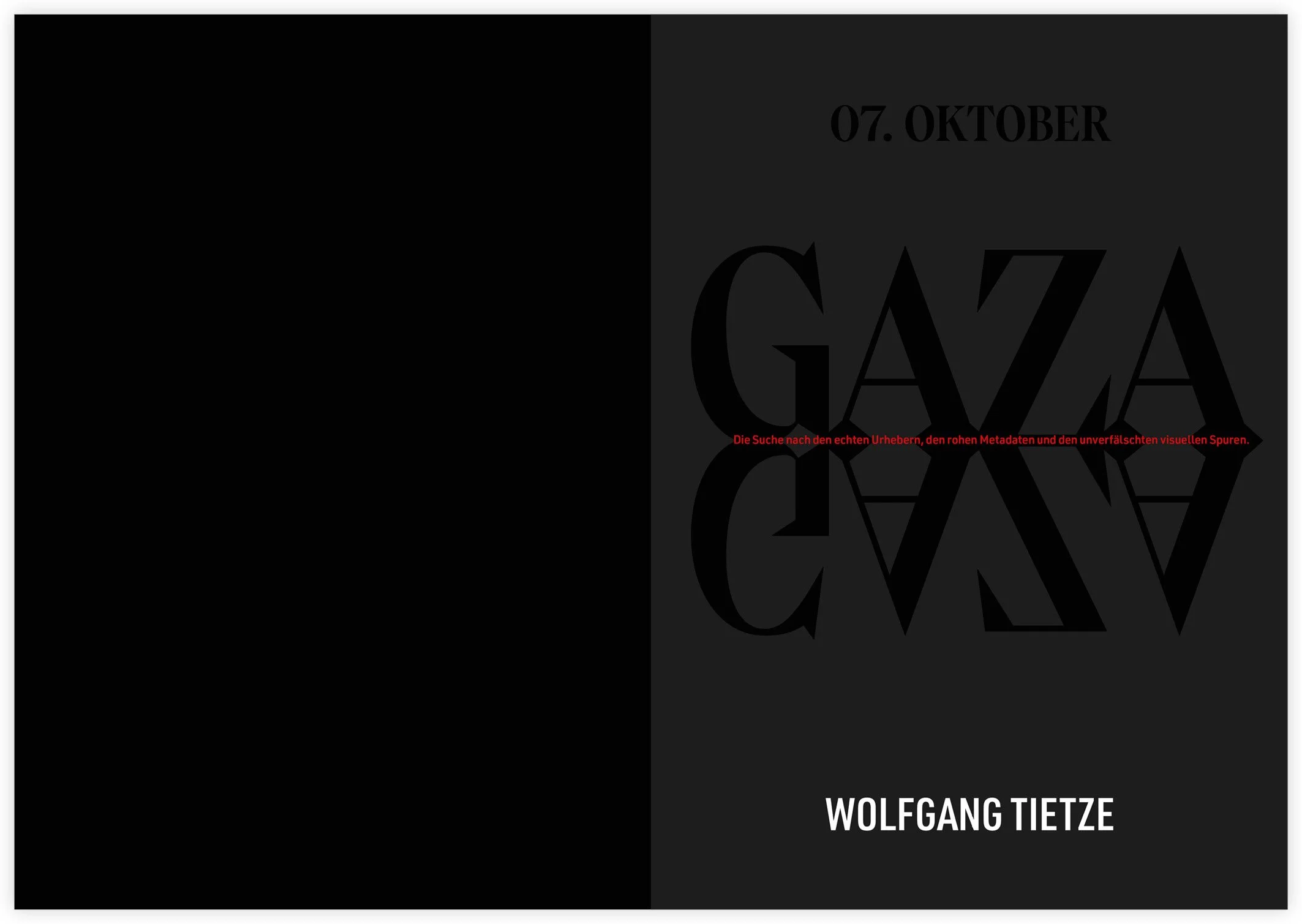
GAZA – 07. Oktober ist Wolfgang Tietzes visuelle Spurensuche nach den Ereignissen des 7. Oktober 2023. Der erfahrene Journalist folgt Videos, Fotografien, Zeitstempeln und Ortsmerkmalen und rekonstruiert den Weg israelischer Geiseln von Nahal Oz durch Gaza bis zum Al-Shifa-Krankenhaus.
Drei Jahre lang fügt Tietze Fahrzeuge, Routen, Kamerapositionen und Urheber wie Teile eines Puzzles zusammen. Er benennt 17 Zeugen aus Gaza und untersucht Bilder, die später mit irreführenden Bildunterschriften veröffentlicht wurden. Sein Buch ist zeitgeschichtliches Dokument und Ermittlungsdossier zugleich – und eine kritische Abrechnung mit Medien und Institutionen, die nicht nachfragten oder nicht antworteten. Die vollständige Dokumentation liegt dem Internationalen Strafgerichtshof vor.
Oktober 2026
Hardcover DIN A4, 208 Seiten, Lesebändchen, Fadenheftung, Falzband
ISBN 978-3-00-089070-3